
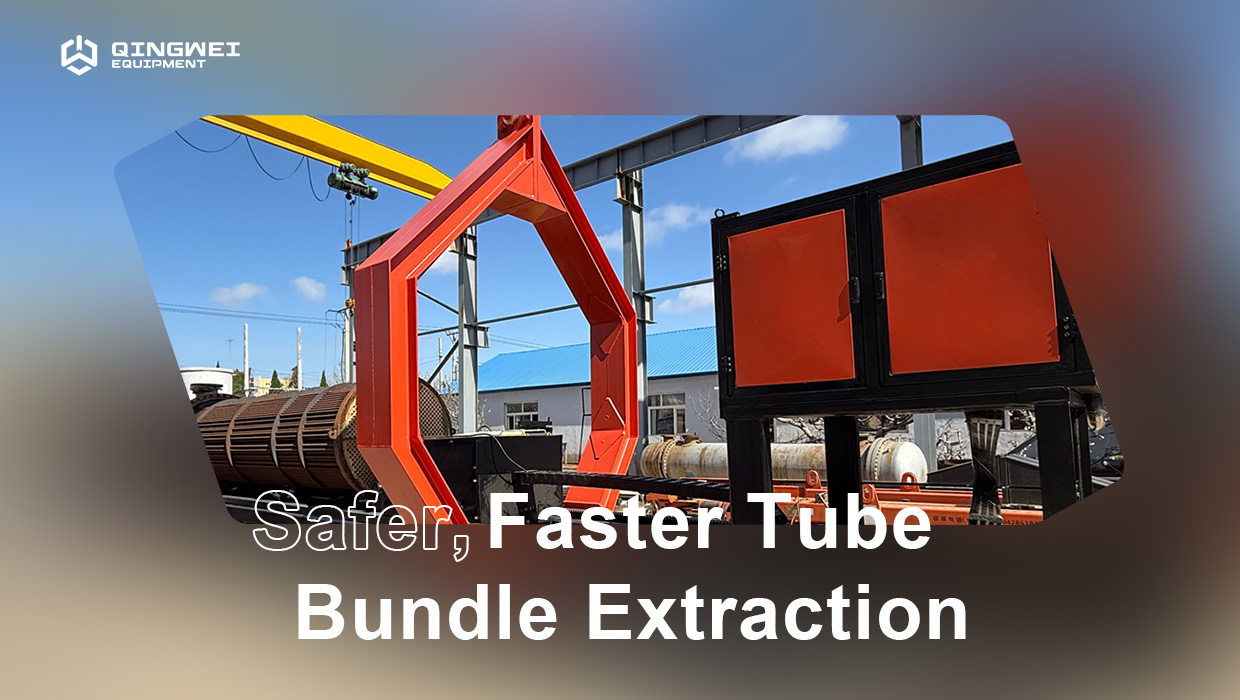
Why pulling force cannot be selected by bundle weight alone
For shell-and-tube heat exchanger maintenance, the rated pulling force of a tube bundle extractor should not be selected only according to the nominal bundle weight. In real refinery and petrochemical shutdown work, the first movement is often the most difficult part because the tube bundle may be affected by fouling, corrosion, tube sheet adhesion, gasket sticking and long-term operation under high temperature.
A bundle weighing 20 tons does not always require only 20 tons of pulling force. When the bundle has not been removed for many years, the initial breakaway resistance can be much higher than the dead weight of the bundle. This is why a reasonable safety margin is important when choosing between 25T, 35T, 45T, 65T, 85T or 100T models.
Main factors that affect the required pulling force
1. Tube bundle weight
The maximum bundle weight is the basic parameter. It should include tube bundle weight, possible fouling deposits and any uncertainty in the heat exchanger drawing.
2. Fouling and corrosion
Heavy fouling, sludge, scale and corrosion can greatly increase the breakaway force. A higher pulling capacity is recommended when the exchanger has been in service for a long time.
3. Bundle length and support
Longer bundles require better support, stable trolley movement and accurate alignment. Pulling force and structural stability should be considered together.
4. Site conditions
Ground level operation, platform work, restricted space, crane access and shutdown schedule can all influence whether a diesel, electric or customized extractor is more suitable.
Suggested pulling force selection reference
The following table is a general selection reference. Final model selection should still be confirmed according to the actual tube bundle drawings, site layout and maintenance conditions.
| Maximum bundle weight | Typical condition | Recommended pulling force | Selection note |
|---|---|---|---|
| Below 15 tons | Light fouling, short bundle, easy access | 25T class | Suitable for smaller exchangers and relatively clean bundles. |
| 15–25 tons | Normal refinery or chemical plant maintenance | 35T or 45T class | Recommended when the bundle condition is uncertain or the unit has been in service for several years. |
| 25–45 tons | Heavy fouling, longer bundle or higher starting resistance | 65T class | Provides a stronger safety margin for sticky bundles and demanding shutdown work. |
| 45–65 tons | Large refinery heat exchangers and critical equipment | 85T class | Suitable for large bundles where extraction stability and safety are important. |
| 65 tons and above | Very heavy bundles, large diameter or severe adhesion | 100T class or customized model | Final configuration should be checked by engineering calculation and layout review. |
Why a safety margin is necessary
During extraction, the initial pulling stage may require much more force than the continuous sliding stage. Once the bundle starts moving, the resistance usually becomes more stable. However, if the selected equipment has no safety margin, the operation may become slow, unstable or unsafe.
For most refinery turnaround projects, Qingwei Equipment usually recommends keeping a 20–30% safety margin. For severely fouled or long-unused exchangers, a larger margin may be more appropriate.
Diesel or electric bundle extractor?
Diesel tube bundle extractors are suitable for outdoor refinery and petrochemical maintenance projects where independent power supply and mobility are important. Electric bundle extractors are often preferred in workshops, plants with stable power supply, or sites where diesel engine operation is restricted.
The choice of power type does not change the basic selection logic: pulling force, bundle length, bundle diameter, working height and site restrictions must still be reviewed together.
Information needed before model selection
- Maximum tube bundle weight
- Maximum tube bundle length
- Maximum tube sheet or bundle diameter
- Working height and lifting method
- Ground level, platform or steel structure operation
- Expected fouling, corrosion or sticking condition
- Available working space in front of and behind the exchanger
- Preferred power type: diesel or electric
Common selection mistakes
- Selecting only by bundle weight: this ignores adhesion and fouling resistance.
- Ignoring the bundle length: long bundles require better support and stable alignment.
- No allowance for site restrictions: limited space may require extension kits or customized layout.
- Choosing the smallest possible model: this may reduce the safety margin during real shutdown work.
FAQ: Tube bundle extractor pulling force
Is pulling force the same as tube bundle weight?
No. Tube bundle weight is only one factor. Fouling, corrosion, gasket sticking, tube sheet adhesion and alignment can all increase the real extraction resistance.
How much safety margin should be kept?
For many refinery maintenance projects, a 20–30% margin is a practical starting point. For severe fouling or uncertain exchanger conditions, a higher margin is recommended.
Can one machine cover different heat exchanger sizes?
Yes. One tube bundle extractor can often be configured to cover different bundle lengths and diameters, but the maximum weight, working length and site layout must be confirmed first.
What information should be provided for a quotation?
Please provide the maximum tube bundle weight, length, diameter, working height, site condition and preferred power type. Drawings or photos are very helpful for accurate model selection.
Need help selecting the right pulling force?
Send us your heat exchanger parameters and site conditions. Our engineering team can recommend a suitable tube bundle extractor configuration for your project.