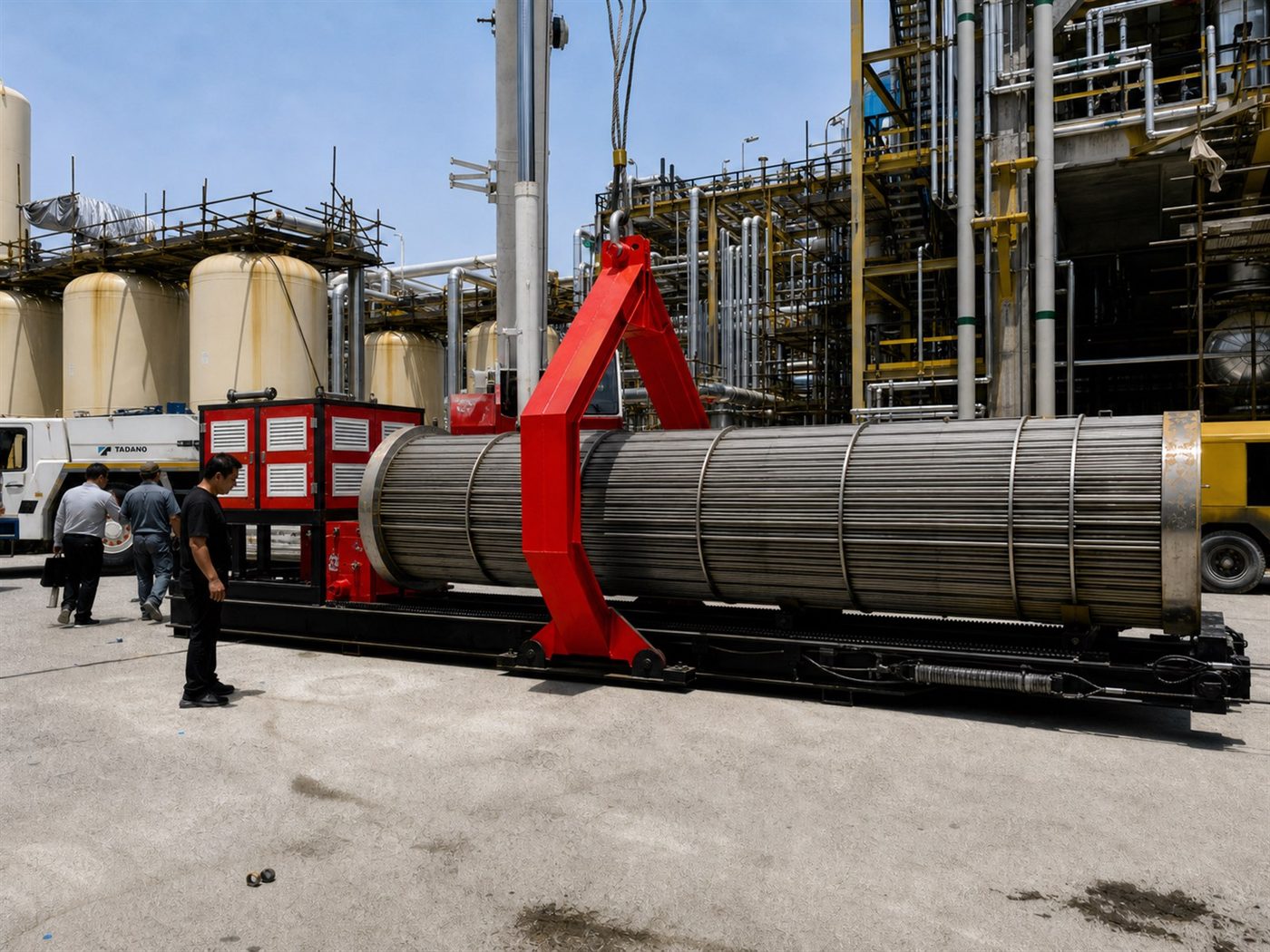
Tube bundle pulling is often planned around pulling force, bundle weight and machine capacity. Those details matter, but in many refinery and petrochemical maintenance jobs the hardest part is not the number on the drawing. It is the working space around the shell and tube heat exchanger. Pipe racks, platforms, cable trays, nearby vessels, scaffolding and other turnaround activities can make a technically simple extraction job difficult to execute safely.
For maintenance contractors, EPC planners and refinery turnaround teams, limited access should be treated as an engineering condition, not an inconvenience discovered on the day of work. A suitable tube bundle extractor or bundle puller can help control the pulling operation, but the site still needs enough room for equipment positioning, bundle travel, support, operator movement and emergency access.
1. Start with the Real Working Envelope
Before selecting equipment, confirm the actual working envelope around the heat exchanger. This includes the straight-line distance in front of the exchanger, side clearance for the machine body, overhead restrictions, available ground or platform bearing capacity, and any obstacles that may interfere with the extracted tube bundle. Drawings are useful, but a current site photo or walkdown is often more reliable because temporary structures and nearby maintenance work can change the available space.
The working envelope should include more than the length of the bundle. It must allow room for the extractor, support points, operators, hydraulic or electrical connections, lifting accessories and safe access paths. If the bundle is long or heavy, the team should also plan where it will rest after extraction and how it will be moved for cleaning, inspection or repair.
2. Check Pulling Direction Before Mobilization
Pulling direction is one of the most important early decisions. In some units, one side of the exchanger may face a road or maintenance corridor, while the other side may be blocked by piping or steel structure. The preferred pulling direction should be confirmed before mobilization, not assumed from the drawing orientation.
When the pulling direction is restricted, the bundle puller may need a compact footprint, adjustable support height or a specific approach route. If the front channel, cover or exchanger head requires crane support during removal, the lifting plan should be coordinated with the tube bundle extraction plan. Overlapping activities in the same narrow area can create delays and unsafe working conditions.
3. Match Equipment Capacity with Stability and Stroke
Pulling capacity is important, especially when the bundle has heavy fouling, corrosion or a long service interval. However, capacity alone does not make a tube bundle extractor suitable for a tight refinery area. The equipment also needs stable support, practical stroke, controlled alignment and enough room for operators to see and control the extraction process.
A high-capacity machine that cannot be positioned correctly may be less useful than a properly configured extractor with stable support and realistic access. Before final selection, review bundle weight, bundle length, diameter, exchanger elevation, nozzle obstructions, ground condition and expected pulling resistance. These details help engineers recommend a safer configuration instead of relying only on tonnage.
4. Plan Bundle Support After Initial Movement
The first movement of the tube bundle is only one part of the job. Once the bundle begins to come out of the shell, the support method becomes critical. The extracted bundle should remain aligned and supported to reduce bending, twisting and local stress on tubes, baffles and the tube sheet. Poor support can damage the bundle even if the pulling operation itself is controlled.
In restricted maintenance areas, there may be limited space for additional rollers, saddles or temporary stands. The team should identify support points before work starts and confirm whether the extractor can support the bundle through the required travel. If cranes or forklifts are needed for secondary handling, their access routes and lifting zones should be reserved in advance.
5. Diesel or Electric: Choose Based on the Site
Power choice is closely related to the working environment. A diesel tube bundle extractor can be useful when the job is outdoors, site power is not available, or the equipment needs to move between multiple exchangers during a shutdown. Diesel power can reduce dependency on temporary electrical supply and make the machine more flexible across large refinery units.
An electric tube bundle extractor may be preferred in workshops, controlled maintenance zones or sites where emissions, noise and indoor operation are important. The right choice depends on access, power availability, ventilation, movement distance, operating restrictions and the maintenance schedule. For some projects, both types may be considered during early planning.
6. Keep the Pulling Zone Clear and Controlled
Restricted access increases the importance of site discipline. The pulling zone should be clearly marked, and unnecessary personnel should stay outside the operating area. Tools, hoses, cables and removed exchanger parts should not block the travel path of the bundle or the movement path of the equipment.
Before pulling begins, confirm isolation status, gas testing requirements, communication signals, emergency access and stop-work criteria. The first few minutes of movement should be slow and controlled because actual resistance may differ from the estimate. If the bundle moves unevenly, makes abnormal noise or shows signs of binding, stop the operation and reassess alignment before continuing.
7. Use Site Photos to Improve Equipment Selection
Good site photos can prevent many selection mistakes. Photos should show the exchanger face, surrounding pipe racks, road access, working height, overhead clearance and available space in the pulling direction. A short video walkaround can also help engineers understand the restrictions that may not appear on drawings.
When requesting equipment recommendations, include bundle weight, bundle length, bundle diameter, exchanger elevation, pulling direction, site access photos and preferred power type. Qingwei engineers can review this information and suggest a practical tube bundle extraction solution for refinery turnaround and petrochemical maintenance work.
Final Thoughts
Tube bundle pulling in tight refinery maintenance areas is not only a capacity question. It is a planning task that connects equipment access, bundle support, pulling direction, power choice and safety control. When these items are confirmed early, turnaround teams can reduce delays, avoid unnecessary site changes and complete heat exchanger maintenance with better control.
If your team is preparing a restricted-access exchanger job, send the basic exchanger data and site photos through our contact page. You can also visit the Qingwei technical blog for more practical planning guides.